Sitecore
SUGCON Europe 2026: Key Takeaways on Content, AI, and Platform Modernization
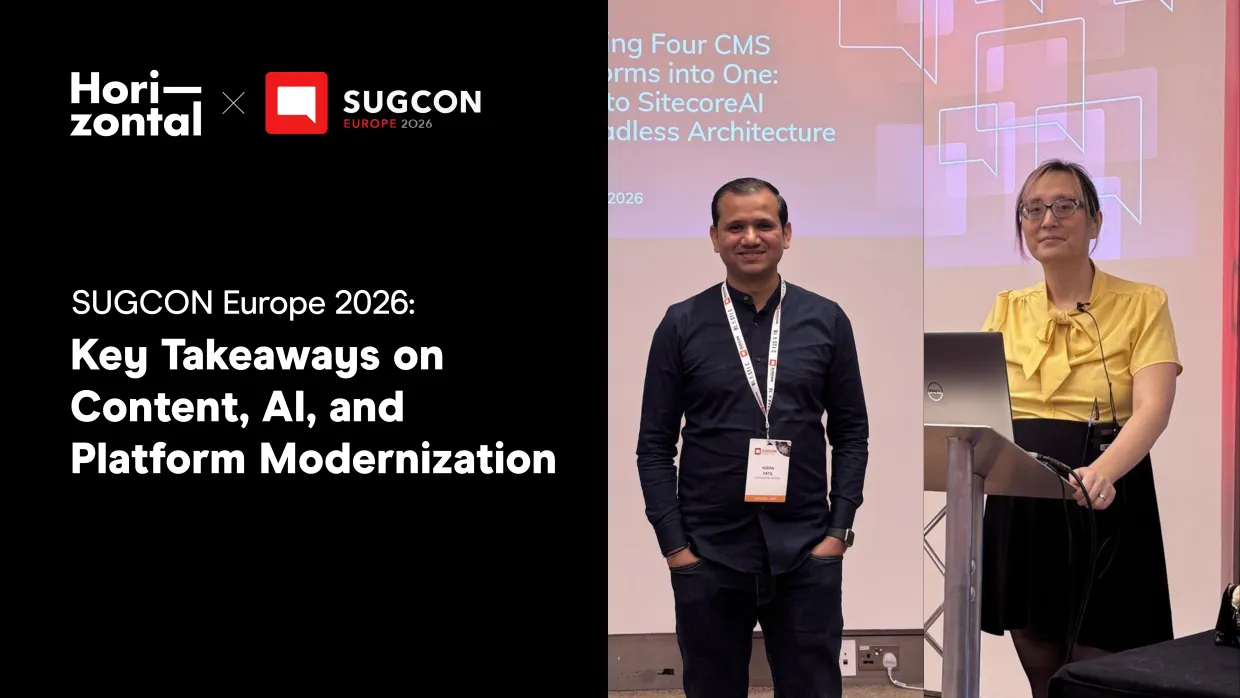
SUGCON Europe 2026 took place on 16th-17th April in London, bringing together digital leaders, practitioners, and technology experts across the Sitecore community to share how content, AI, and digital experience platforms are changing in practice. Discussions this year reflected a clear shift in enterprise priorities: less experimentation, more execution. Below are the key insights from across the event and what they mean for organizations navigating content, AI, and platform modernization.
Enterprises are less interested in exploring what AI and modern architecture might one day do, and more focused on making it actually work inside their organizations. The clearest message across the event: the next phase of digital transformation will be shaped by how well organizations can structure content, simplify their platform estates, and apply AI in ways that reduce operational burden rather than add to it.
Content structure is becoming a strategic priority
As AI changes how content gets discovered, summarized, and reused, structure matters more than it used to. Content built for human readers alone is no longer enough. It also needs to work for machines, whether that means AI-driven discovery, automated reuse, or consistent delivery across channels. For most enterprise teams, the challenge is not producing more content; it is making sure what they already have is well-organized, reliable, and built on solid governance foundations.
Practical AI is creating the most value
The most grounded discussions at SUGCON centered on AI that removes friction rather than promises transformation. Content workflow acceleration, localization support, and consistency at scale are the use cases gaining traction. They are not glamorous, but they are delivering real operational value. AI is becoming less of a standalone topic and more of a practical enabler, and that is a healthy direction for the industry.
Authenticity at scale depends on stronger systems
Scaling content across markets and teams creates an authenticity problem. Brand voice drifts, inconsistency creeps in, and teams across regions end up pulling in different directions without necessarily realizing it. AI, used carefully, can support tone alignment, reduce duplication, and flag inconsistencies before they compound. The conversation at SUGCON made clear that maintaining authenticity at scale is as much an operational challenge as a creative one.
Platform extensibility and ecosystem maturity matter more than ever
Enterprises are scrutinizing platforms more carefully than they were a few years ago. The questions have shifted from what a platform can do in isolation to how well it integrates, how easily it can be extended, and how much overhead it creates to maintain. SaaS delivery models, composable architectures, and AI-enabled workflows are all part of this. Organizations want platforms that are practical to govern and flexible enough to evolve, not just powerful out of the box.
Horizontal's session: Unifying four CMS platforms into one
Our own session, presented by Kiran Patil and Sophia Ly, addressed a challenge many large enterprises know well: consolidating multiple CMS platforms without disrupting business continuity. The discussion explored how that kind of modernization, done properly, delivers more than technical clean-up. It creates the operational consistency and architectural flexibility that organizations need to keep pace with what comes next.
Why this matters for enterprise digital strategy
The organizations that will navigate this well are those treating content, architecture, and AI as a connected set of decisions rather than separate work streams. The priorities emerging from SUGCON are not new, but they are sharper. What the event reinforced is that experimentation alone will not get organizations there. Sustainable progress means turning strategy into something that can actually be repeated and scaled.