Sitecore
Sitecore acquires Scrunch: A practical step toward agent-ready digital experiences
In its 25th Anniversary year, Sitecore's $225 million acquisition of Scrunch is a significant moment for brands already thinking seriously about AI search, content operations, and the next phase of digital experience - and certainly for those already operating with, or considering, Sitecore AI.
By James Gray, Digital Strategy Director (UK), Horizontal Digital
The deal brings Scrunch's AI search visibility and Agent Experience Platform (AXP) capabilities into the Sitecore ecosystem at a time when customer discovery is changing quickly. Sitecore's announcement positions the acquisition around helping brands influence discovery and buying decisions in the AI-search era. For Sitecore customers, the opportunity is clear: make more of the content they already own easier for AI systems to find, interpret, and use.
That timing feels deliberate. In Sitecore's 25th anniversary year, and just days before the company gathers in Copenhagen for its anniversary celebrations, the Scrunch deal lands as more than a product expansion: it signals where Sitecore believes the next chapter of digital experience is heading.
As Eric Stine, Sitecore's CEO, put it when announcing the acquisition, "For 25 years, our mission has been simple: help buyers find you, trust you, and choose you. And now we have a more seamless way to do just that." It would be no surprise if that theme is unpacked further in Copenhagen this week, with the acquisition used to connect Sitecore's heritage in digital experience with its more agent-ready future.
Why Scrunch matters to Sitecore customers
Scrunch helps brands understand how they appear in AI search. Its platform tracks visibility, citations, prompt performance, competitor presence, AI traffic, and crawl behavior across major AI systems. It is trusted by more than 500 companies and agencies, including Lenovo, Skims, Crunchbase, and Penn State.
Those capabilities answer a set of questions many brands are only beginning to ask: where are we appearing in AI-generated answers, which competitors are being cited instead of us, which pages are AI crawlers using, which important content is being missed, and where are agents struggling to retrieve or understand our information. These questions matter because AI discovery is not only a marketing visibility issue, but affects consideration, perception, and commercial outcomes.
The most significant part of the acquisition, however, is Scrunch's Agent Experience Platform (AXP). Scrunch describes AXP as a way to detect AI agents at the edge and serve them AI-optimized content without disrupting the human experience. Its own positioning is direct: "Your site isn't built for AI. Now it can be."
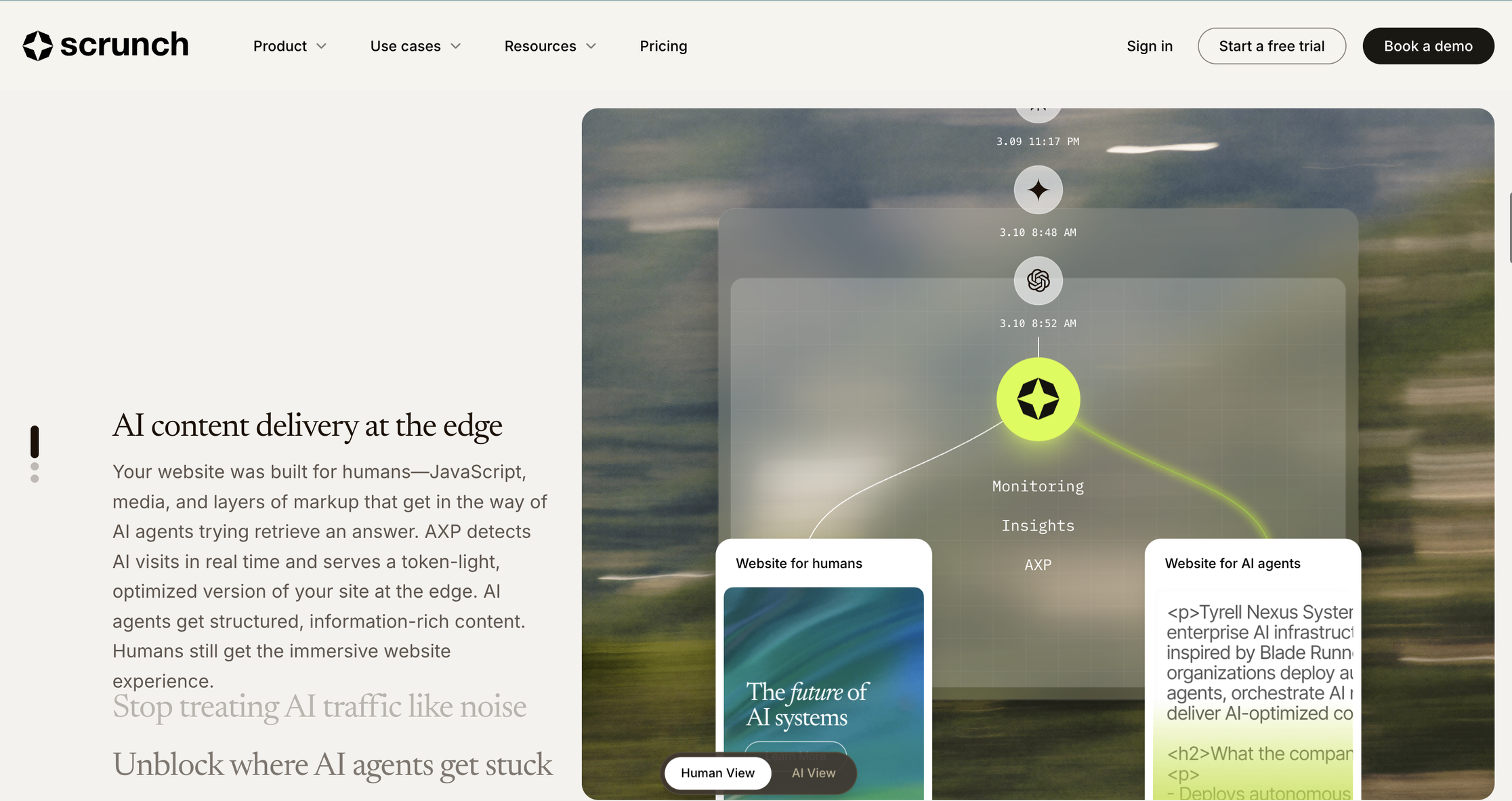
Scrunch's AXP serves a clean, structured version of your site to AI agents while preserving the human experience.
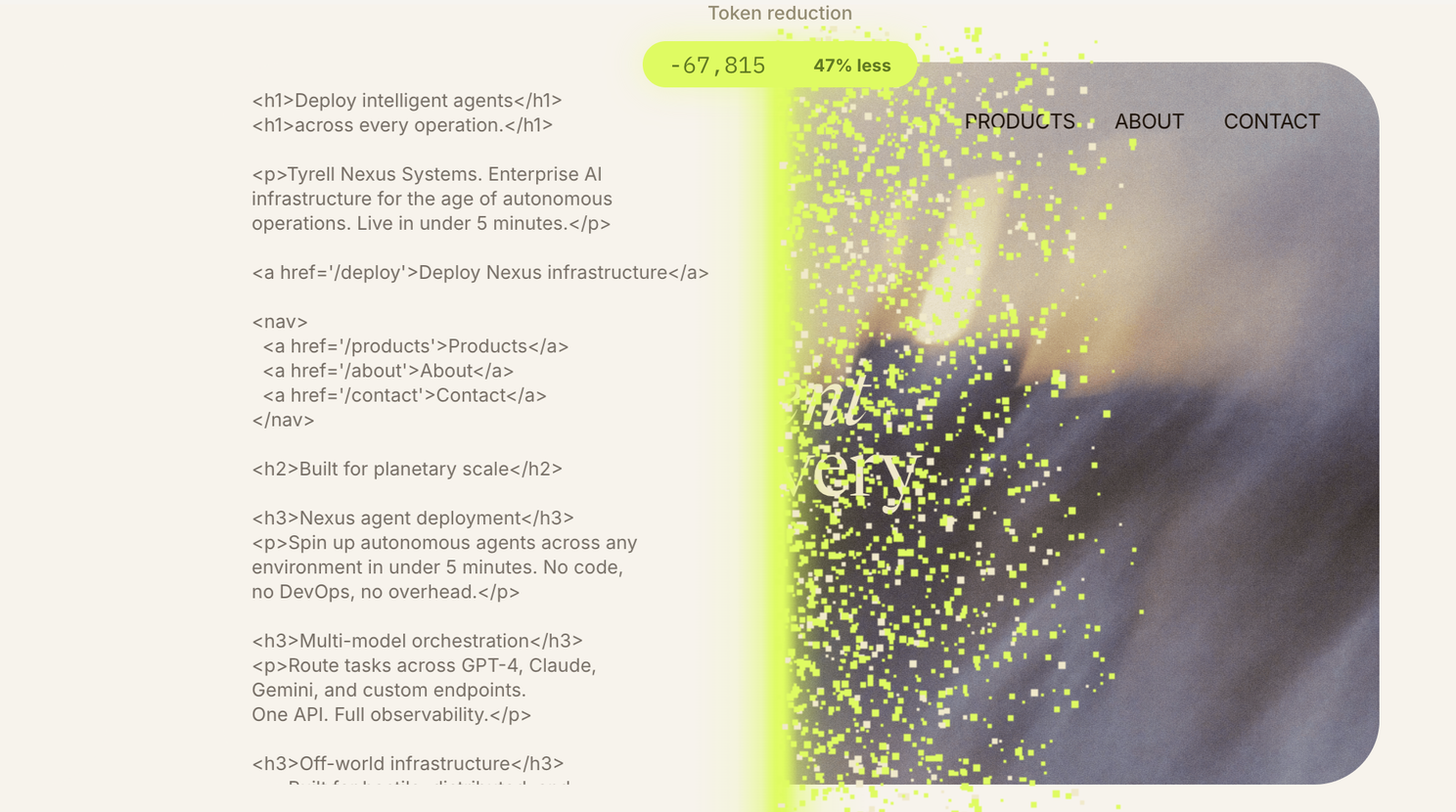
AXP reduces token bloat significantly, stripping out noise while preserving meaning for AI agents
Most large digital estates were designed for human interaction. They include rich media, JavaScript, layered markup, personalization, campaign components, analytics scripts, complex navigation, and dynamic content. Those experiences can be valuable for people, but they can also make it significantly harder for AI agents to retrieve concise, structured answers. AXP addresses that by giving AI agents a cleaner, more structured version of the content while fully preserving the existing human experience.
Early performance data supports the potential. You can also see AXP in action in this short video from Sitecore.
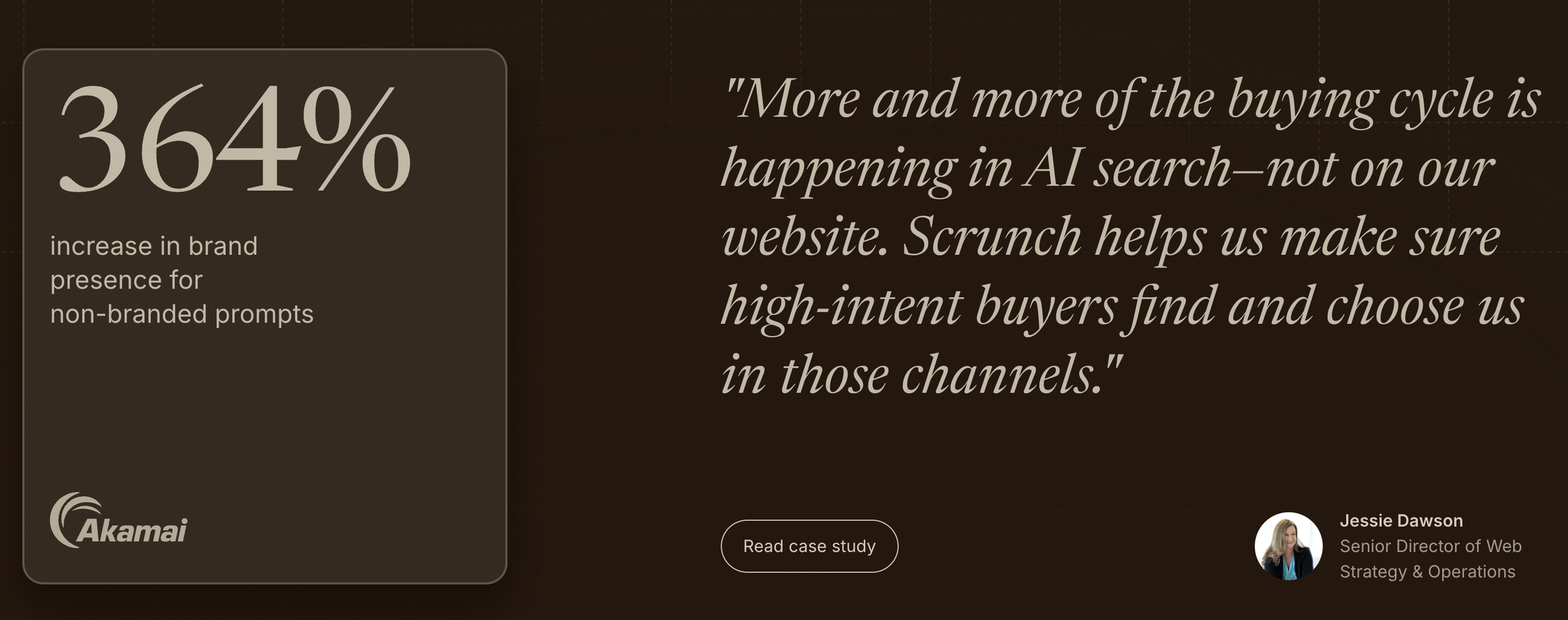
Akamai found AXP-enabled pages achieved a 364% increase in brand presence for non-branded prompts
Akamai evaluated AXP-enabled webpages against comparable non-AXP pages across tracked AI search prompts and models, finding a 364% increase in brand presence for non-branded prompts and a 218% increase in citations in AI-generated results. Runpod reported a 400% increase in paying customers linked to AI search optimization efforts using Scrunch. These numbers should not be treated as universal benchmarks, but they indicate that AI accessibility and content clarity can have meaningful commercial value.
The website is still critical, but its role is changing
No one should interpret this shift as the end of the website. It remains the core owned environment for brand storytelling, product education, customer support, conversion, service and trust. It is still where many customers validate what they have heard elsewhere.
The change is where discovery and evaluation begin. A buyer may now ask an AI assistant to shortlist providers, compare features, summarize reviews, or recommend the best solution for a particular use case. The answer may be assembled from a mix of brand pages, third-party sources, reviews, documentation, and structured data. If a brand's own content is unclear, inaccessible, inconsistent, or hard to parse, AI systems may rely on other sources, like citing competitors, omitting important differentiators, or surfacing outdated information.
The aim is not to create more content for the sake of it. Most enterprise brands already have a significant amount of content. The issue is whether that content is clear, current, structured, and available in a form that AI systems can use. The companies that win will not simply publish more. They will surface more of the right content, more succinctly, to the systems shaping buyer decisions before the buyer ever lands on a page.
Why this fits with SitecoreAI
Sitecore's AI search platform, now strengthened by the Scrunch acquisition
The acquisition fits the direction Sitecore has already been taking with SitecoreAI, which is positioned around helping brands plan, create, personalize and deliver content across digital channels, supported by embedded AI and agentic workflows.
Sitecore's announcement states that Scrunch recommendations will be automated within SitecoreAI Content Management, Content Marketing and DAM solutions, and that Scrunch connects directly into Sitecore workflows (rather than functioning as an add-on, it will operate as a working layer across the content supply chain). AI visibility will not be solved by a disconnected dashboard. Brands need the insight, but they also need the operating model to act on it, i.e., content owners, workflows, governance, metadata, structured content, and the technical foundations to support ongoing optimization.
In practice, a team could identify that a key product page is being crawled but not cited, that competitors are being used as sources for specific prompts, or that pricing and service details are not being retrieved clearly. They could then update the source content, enrich metadata, improve schema, and expose a cleaner agent-ready version, all within the same content and experience ecosystem.
What Horizontal Digital will help clients do next
For our clients, the focus is straightforward: turn this acquisition into practical advantage. That starts with understanding which AI-mediated journeys matter most, the questions, comparisons, use cases, and decision moments that influence real customer outcomes.
From there, our teams help clients assess the content estate by looking at content structure, metadata, schema, page templates, component design, DAM governance, taxonomy, and content ownership to identify where valuable information exists but is not easy enough for people or machines to use. We also help modernize the Sitecore foundation. Our HyperX accelerator supports faster, cleaner SitecoreAI migrations with reusable components and modern architecture, reducing implementation timelines by 50% and increasing content speed to market by 35%.
Horizontal Digital brings deep Sitecore expertise to this work, 25 Sitecore MVPs, more than 100 successful implementations, and our teams who are already well placed to help clients answer the harder questions: which content should be exposed to AI agents first, which journeys are most exposed to AI-mediated comparison, which pages need clearer summaries or product details, and how AI search visibility should be measured alongside traditional performance data.
A practical opportunity for brands
Sitecore's acquisition of Scrunch gives enterprise brands a clearer path into AI-search readiness. It connects AI visibility with the systems that manage content, assets, workflows, and digital experiences. It gives Sitecore customers a way to understand how agents interact with their content and a route to improve how that content is served.
For clients, the immediate opportunity is not to chase every new optimization trend. It is to strengthen the foundations that make content useful wherever customers encounter it: clearer content, better structure, stronger governance, cleaner delivery, more useful metadata, and more reliable answers.
That is how brands will improve their chances of being found, cited, and recommended in the next phase of digital interaction. The winners will be those that surface more of the right content, more succinctly. Sitecore's acquisition of Scrunch makes that a more practical ambition for Sitecore customers — and it gives our teams another important capability to help clients build for what comes next. Find out more at sitecore.com/platform/ai-search.
If you are in Copenhagen this week, come and speak to us, or to our valued clients IFS and Greystar, about where the Sitecore platform is heading and what this shift could mean in practice for marketers, content teams and digital leaders. The most useful conversations now are not about AI in the abstract, but about how brands prepare their content, platforms and operating models for a world in which discovery, evaluation and recommendation are increasingly shaped by agents.